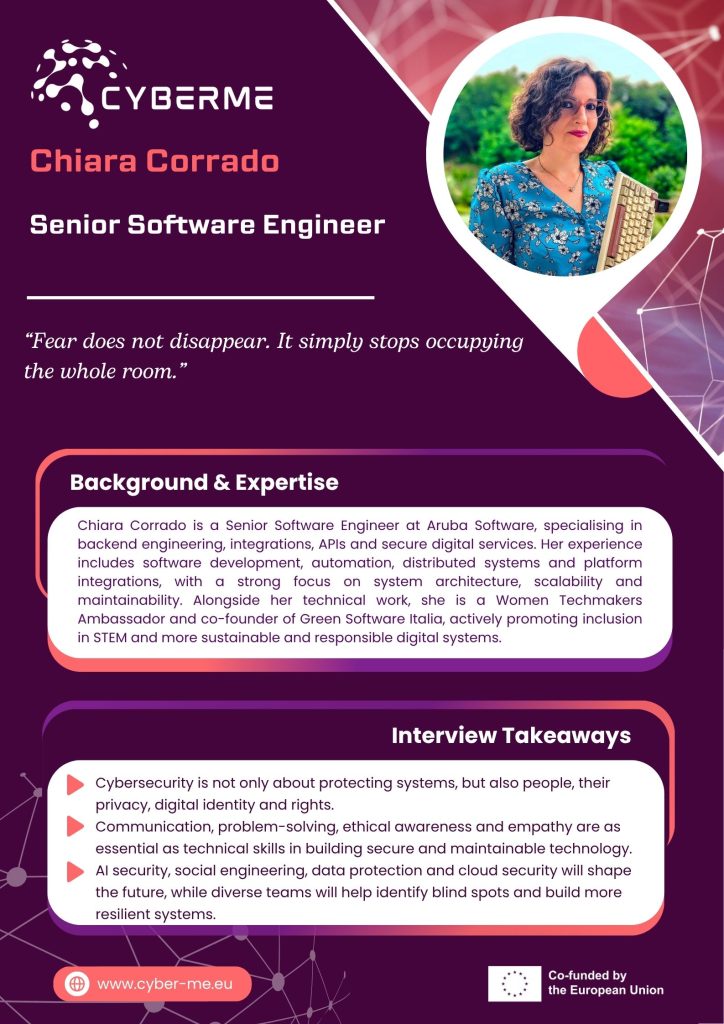
How can you find your place in technology? In this Chiara Corrado interview for CyberMe, we explore skills, confidence and inclusion.
Chiara is a Senior Software Engineer at Aruba Software. She works on software development, integrations and secure digital services. She also supports women in STEM and promotes more sustainable technology.
CyberMe encourages young women to explore cybersecurity through experiences and female role models. Following the story of Floriana Ferrara, we meet another professional who puts people at the heart of technology.
Interview adapted for clarity and readability.
Meet Chiara Corrado
Tell us a little about yourself.
I am a Senior Software Engineer at Aruba Software. I mainly work on platform integrations, APIs and secure digital services.
Over the years, I have also worked on automation and distributed systems. I enjoy designing software that can grow and remain easy to maintain over time.
Alongside my technical work, I support inclusion in STEM: science, technology, engineering and mathematics. I am a Women Techmakers Ambassador and collaborate with organisations supporting women in technology.
I am also co-founder of Green Software Italia. This community promotes a more sustainable and responsible approach to software.
I believe technology is never neutral. The systems we build influence people, opportunities and access to services. That is why I also care about ethics, inclusion and social impact.
Finding a Path into Cybersecurity
What brought you closer to cybersecurity? How can we make this path more accessible to young women?
First of all, curiosity. I have always been fascinated by how systems work and where they can fail.
Over time, however, I understood something else. Cybersecurity also protects people. Privacy, digital identity and access to services are human issues before they are technical ones.
For many young women, the greatest challenge is feeling that they belong in these spaces. Sometimes you feel different before you even speak.
That is why visibility matters. Seeing other women working in cybersecurity makes that career feel possible.
We therefore need mentors, welcoming communities and accessible events. But we must also accept imperfection. You do not need to know everything before starting: we are all still learning.
Skills Beyond Technology
Which soft skills matter most in your daily work?
Technical knowledge is essential. However, it is rarely enough on its own.
Communication is one of the most important skills. Complex systems are built by teams. Explaining a concept clearly therefore helps prevent misunderstandings.
Problem-solving also requires a wider view. You need to understand the whole system and consider the consequences of your decisions.
Ethical awareness matters too. Engineers influence data management, digital identities and artificial intelligence systems.
We should therefore ask ourselves: can we build it? Should we build it? What consequences will it have?
Finally, empathy matters greatly. A good system must be understandable, maintainable and safe for other people.
Making Someone Feel Less Alone
Can you share a moment that reflects the impact of your work?
One of the achievements I am proudest of concerns people.
For a long time, I was afraid of public speaking. I started by writing online, in spaces that seemed to have very few readers.
Then I began organising events, mentoring and moderating discussions. Eventually, I spoke at conferences about technology, inclusion and sustainability.
The most meaningful moments came afterwards. Someone would tell me: “I felt less alone.”
That sentence changed how I see impact in technology. We can also build spaces where people feel welcome and free to be themselves.
Learning While Facing Self-Doubt
How do you stay up to date, and what challenges have you faced?
Technology changes quickly. Continuous learning is therefore part of my everyday life.
I experiment, follow open-source projects and participate in communities and conferences. I also learn a great deal from other professionals.
However, one of my biggest challenges was personal. I often felt I had to prove more before speaking or considering myself sufficiently prepared.
Over time, I realised that confidence grows gradually. It develops through experience, relationships and continuing even when you feel uncomfortable.
Another challenge is balancing depth with breadth. Cybersecurity and cloud technologies cover enormous areas.
We cannot know everything. Learning to collaborate, ask questions and adapt therefore becomes essential.
Balancing Work and Personal Life
How do you balance your career with your personal life?
Honestly, I am still learning.
Technology can take up a lot of time. Community work also often continues beyond working hours.
However, I have realised that sustainability applies to people too. That is why I protect time for nature, travel and the people I care about.
Even a walk can help me slow down. Setting boundaries matters, especially when working remotely and staying constantly connected.
Balance also changes over time. Some periods are more demanding than others. We therefore need to recognise when to rest before burnout starts feeling normal.
Chiara Corrado’s Message for CyberMe
What message would you share with young women interested in technology?
There is a sentence that means a lot to me:
“Fear does not disappear. It simply stops occupying the whole room.”
We often think confidence means having no fear. In reality, we can grow while still feeling uncertain.
You do not need to be perfect to enter STEM or cybersecurity. Instead, you need curiosity, consistency and the courage to keep learning.
Sometimes it begins with choosing to take up space despite the fear.
What Comes Next for Cybersecurity?
Which topics will become central in the coming years? What role will diversity and inclusion play?
AI security will be one of the main topics. This includes protecting models, managing data and addressing misinformation.
Attacks that exploit human behaviour will also keep evolving. With generative AI, fake emails and messages can look extremely realistic.
As a result, spotting obvious mistakes or suspicious wording is no longer enough. We need greater awareness, including cultural awareness.
Data protection, digital identity and cloud security will remain important. Supply-chain security and control over digital infrastructure will also receive greater attention.
Diversity has a practical role in all of this. People with different experiences can identify risks that others might overlook.
Inclusion therefore improves the quality and resilience of the systems we build.
The future of cybersecurity will need safer technology and more diverse voices helping to shape it.
Explore Chiara’s work and initiatives on her personal website.